
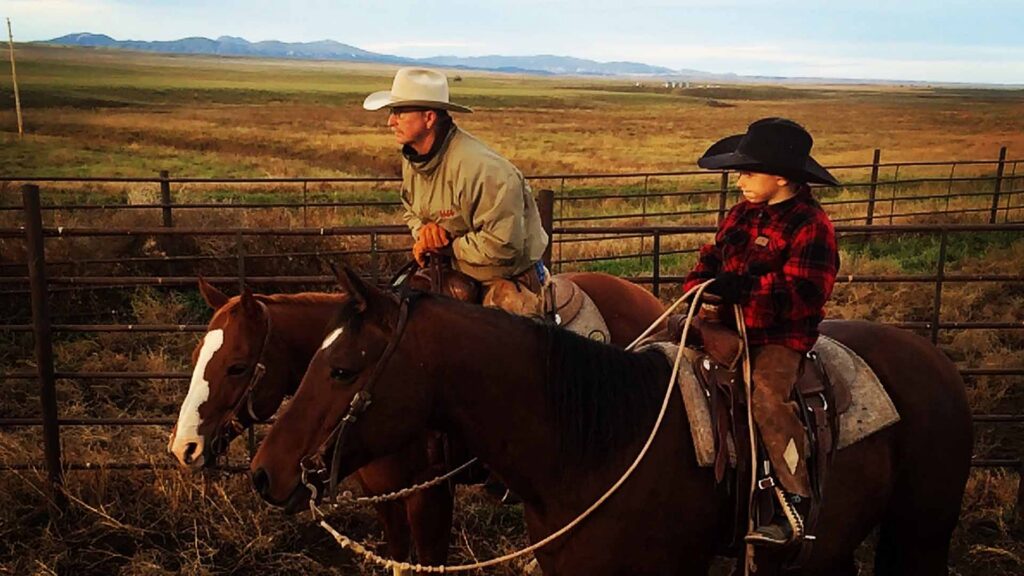
Since its founding in 1930, the Texas Cowboy Reunion has stood as a proud tribute to the early-day traditions of Texas ranching, honoring the cowboys who built the foundation of the cattle industry. In 2001, the Reunion took that purpose one step further by formally recognizing those who have committed their lives to the working cowboy lifestyle. Each year, one deserving individual is named the Working Ranch Cowboy—a title reserved for those who exemplify the values, toughness, and heritage of the profession.
This year, at the 96th Texas Cowboy Reunion, that honor is awarded to Joe Lethers, President of Operations of the 6666 (Four Sixes Ranch).
As told by Louise Leathers
CHILDHOOD
Joe was reared as a cotton farmer’s son. When Joe was 18 months old, the homesteaded family home burned to the ground, which set his parents back financially, from which they lever recovered. Joe’s mother went to work outside the home, and eventually, Joe’s father had to seek additional work away from the farm to supplement income, only returning on the weekends.
Joe’s early memories include sleeping in a toe sack hanging from the tractor as his daddy plowed. As he got older, he napped at the end of the cotton rows, again as his father plowed and planted. He attributes his deformed hands, which are permanently clenched in fists, to the countless hours spent gripping a hoe handle while persistently fighting weeds. When Joe was about 7 years old, his brother left home, leaving Joe as the only sibling to help on the farm. He was quickly trained to drive the tractor and carried much of the weight of farm chores in his father’s absence. Joe can remember the cotton stripper being broken one autumn, resulting in the hiring of people to pull the cotton. Joe, too, was given a sack and pulled by the side of a woman who taught him how to pull cotton.
LATE TEENS-EARLY ADULTHOOD
To make money to purchase his own clothing, car, and school needs, Joe worked for neighboring farmers by building fence, moving pipe, and helping local contractors.
Because he was not allowed to participate in extracurricular activities at school until he could transport himself to and from school, Joe considered most school activities of little importance. Those activities did not provide monetary compensation, nor did they often provide lasting relationships. As a result, Joe focused on the work he could find. For 2 years, Joe worked at the local meat locker in Clarendon while attending college. There are two huge benefits from which that experience contributed to his career: he learned how to recognize and process high-quality beef, and he learned how to speak conversational Spanish.
When Joe was 19, he married his high school sweetheart, Louise Leathers. They moved to Goodnight, Texas, in July 1977 and worked for Nick Holt from Holt Brothers in Gruver, Texas.
They lived in Goodnight for 4 years had had 2 boys, David and Jonathan. In the late summer of 1981, Nick moved Joe and Louise to Gruver where they lived for 1 year before being moved again to Guymon, Oklahoma. Nick ran about 10,000 Mexican yearlings on wheat pasture a year. As the steers were processed and released on wheat, cowboys were sent out in pairs to head, heal, and doctor the sick ones. Nick never had more than 3 teams and usually about 2 teams of men to doctor yearlings. At times it was only 1 team to doctor cattle. Doctoring honed Joe’s roping skill. He often said his arms and shoulders would be so tired that he learned to only swing once…and catch with the first loop. (Joe has no shoulder or wrist left today as a result) As they kept track of the amount of medicine used, it was not uncommon to doctor at least 100 head per day per team.
It was also at Holt Brothers Joe learned a lot about breaking horses. Nick had a stud that was a “bucking horse” reject. As a result, every horse Nick raised had a propensity to blow up at the most unlikely moment. Joe often said you could never depend on the horse in a tight spot when a calf was on the end of a rope. Their first response was to pitch. During the 11 years Joe worked for Nick, he broke 68 colts. If there were any dependable horses, Joe had very few as he was given the ones no one else could ride. His summers were spent breaking horses and the fall, winter, and spring months were shipping, doctoring, and moving to grass pasture the thousands of wheat pasture cattle. It was not uncommon for Joe and one other cowboy, Todd Browning, to move several hundred head by themselves.
As a result, a couple more vital skills were learned for Joe’s career: it does not take a huge crew of men to do a job. It takes thinking way ahead, and the few men you have must be highly skilled. He also stored a vast amount of knowledge regarding horsemanship while working for Holts.
TURNING 30….
LARRY THOMPSON’S
Larry Thompson was a businessman. He saw the value in the stability of cows and calves, the faster yet riskier return of yearlings, and the backup plan of farming for winter grazing as well as summer harvest. It was working for Larry that Joe always said he got his “college degree”.
Personally, I think a man finally comes into manhood about 30 years old. The year Joe turned 30 was the year he moved his family from Holt Brothers to work for Larry Thompson in 1988….and grew into serious manhood. Those 4 years working for Thompson’s were the hardest years of his young family’s life. With those years came tremendous financial and personal loss. There were, however, the blessings of 2 additional children. Sarah and Anna were born to their little family at the most inopportune time, but with them and the trials during those years taught valuable personal and career lessons: Joe learned how to shape cattle for the feedlot and humility and compassion for employees. Whether owned by an employer or by us, we realized we are merely stewards. Hold to THINGS loosely, hold to our loved ones TIGHTLY, and trust ONLY God! As a result, Joe treats his employer’s ranch and belongings as if it was the Lord’s and for which he is a steward, and he treats his employees with the respect, love, fairness, and value the way in which he desires to be treated.
MOORHOUSE RANCH CO.
It is often said of Tom Moorhouse that he was born 100 years too late! That was is no understatement. Joe planned to go to work for Tom Moorhouse and Moorhouse Ranch Co. on April 1, 1992. We moved in on March 27. Tom cannot stand to see anyone not working, so instead of giving a little time to hang a picture and assemble a bed before April 1, Joe was put right to work. I think the first thing he did was roll his bed on the ground or in a bunkhouse at Pitchfork. Tom neighbored with his brother, Bob, who was managing the Pitchfork’s at the time. That was the beginning of many nights away from home during the next 7 years. It was during these 7 years that we literally became part of the Moorhouse family. We lived next door to Togo and Lucille Moorhouse which placed our family in an ever-watched glass house. David and Jonathan (Cotton) came to be a vital part of the Moorhouse workforce because the employees had more kids than Tom had help. All the kids became the crew which posed its challenges as a wagon boss, but every one of those kids grew up knowing how to work and excel at whatever skill they chose to pursue. It was at Moorhouse’s that Joe swam rivers horseback, made midnight drives by moonlight, worked with broken ribs or bones, received opportunities to learn from some of the greatest horsemen like Ray Hunt, wore out 2 saddles, broke colts on mountain slopes, learned the art of working men, traveled hundreds of miles to work cattle, slept about 100 nights a year in a bedroll, honed his horsemanship, and won the first RHAA World Championship on a horse called Shady. It has often been asked of Joe if he has ever slept in a wet bedroll. His answer? “No, but I’ve laid awake in a lot of ’em!” He’s lived days without a bath except in a stock tank, he’s endured every kind of weather to hit his teepee including blizzard, torrential rain, tornadic winds, blistering heat, attack from mosquito swarms, and fire ants in his bedroll. He’s burned holes in the soles of his boots trying to warm himself by a fire he could not feel and he’s eaten more “plow disc fried meat rolled in a tortilla” than he ever cares to eat again. It was at Moorhouse’s Joe felt he earned his “master’s degree”. His career and life lessons there include:
doing huge jobs with few men and keeping their morale at peak performance, and developing the courage to take cattle long distances in adverse conditions
FOUR SIXES RANCH
It is his time spent at the 6666 Ranch for which Joe will probably be remembered. However, without the foundation and skills taught and learned of Holt Brothers’, Thompson’s, and Moorhouse’s, the things for which Joe will be remembered would not have come to fruition.
That being said, Joe refers to the 6666 Ranch as his “doctorate degree” in ranching. August 1, 1999, began what Joe felt was less than a lateral move from Moorhouse’s. He was no longer the Wagon Boss, but it was a much-needed reprieve for his family. The boys were pretty much grown and gone from home. Joe’s daughters needed him as a father. Life as a camper on North Camp for the next 5 years afforded Joe the chance to develop the relationships missed with so much time away from home. He also served our little church as pastor for 2-3 years studying his Bible as he fed cows in the winter. He also focused on horsemanship even more as he worked with Joe Wolters and added to his tool box of knowledge. I once asked Joe if he missed ole Shady from Moorhouse’s. He replied, “I have an entire pen full of ‘Shady’s standing out there!” What a change it was from riding bucking stock in the early years to riding some of the best working cow horses ever bred!!!
So many of the years to follow are fit for an extensive book or conversation where the names should be changed to protect those still living. It is a fascinating “God Story” that most certainly needs to be told as He is the One to get the Glory and not Joe Leathers.
However, for purpose of this writing, I shall only hit the facts as they are publicly known. It HAS been interesting to hear the rumors that have spread over the years regarding these events. I am so thankful we were oblivious to them as it might have affected Joe’s zeal for service and leadership.
Joe is a unique individual. Years ago, we took a Spiritual Gifts Test which yielded something our pastor had never encountered. Joe tested incredibly high in 2 categories—2 OPPOSING categories-Service and Leadership. Comparing all the gifts, he was 80-85% in both!! How can that be? The only answer?
“Watch him…listen to him…and learn!”
Joe became Wagon Boss of the 6666 Ranch in the fall of 2004. A series of events happened only 6 weeks after taking on that responsibility that led to a move to Dixon Creek as division manager. It was the trials and decisions made during those 4 years that established Joe as a capable representative and spokesperson for the ranch.
One of the decisions he made there was moving the 9 irrigation wells powered from diesel to electricity. At the time, diesel was well over $4.00 / gallon. The nation was experiencing the highest fuel costs we had ever experienced which was wonderful for Burnett Oil…..not so much for Burnett Ranches. The projected payback on the investment from changing fuel sources was projected to be at most 2 ½ years. The payback was actually 1 ½ years saving a tremendous amount of money.
Another challenge Joe took on was cleaning up the oil field mess that was all over the ranch. He negotiated when oil companies would negotiate, he held out benefits that were historically afforded the companies to use as leverage to clean up their “pump and dump” mentality, and he entorced invoicing tor damages which was a practice that had tallen by the wayside unnoticed. Slowly and gradually, the landscape of the ranch was taking shape and cleaning up.
2006 was the year that defined who Joe was as a leader. February 2006, the railroad started a fire that quickly sped across our ranch and even right up to the back of the ranch houses at Headquarters. It was so close it melted the tires on one of the children’s bicycles. The winds were terrific that year and for the next month, Joe headed the investigation to get restitution from the railroad. He was just completing that investigation and handed it off to the various lawyers and insurance companies when exactly one month later in March, 2006, another fire broke out on a very windy day. This fire took 7 lives, various homes, neighbors’ ranches, and for some, entire herds. We lost a lot of cattle in that fire. The men fought fire all night and well into the next day. At the time, it was noted as the largest fire in Texas history. Who knew that record was to be broken in just about 5 years. Having just finished one investigation; Joe quickly began the next. This time, he was not only fighting for the 6666 Ranch and its liability for the ignition of such devastation, but the collected information would be used by our neighbors for their restitution as well.
Indeed, the fire was started by the negligent practices of an oil company. Joe found the evidence within 24 hours of ignition and was confirmed by the State Fire Inspector. This, too, was a story too long to tell and is left for another day. But it was the grace and strength Joe exhibited during the next 2 years that defined his stamina, his ability to speak not only on behalf of the 6666 Ranch but to Texas Congress and Senate. He worked to develop policy to tighten regulations on oil companies. He was so grateful that Anne Marion, though a wildcatter herself, had given her full support for his tireless effort for land stewardship.
Another turn of events brought Anne and John Marion to our door on July 27, 2008. Anne had made an administrative change to the ranch and asked Joe to move back to Guthrie, Texas, to be the General Manager. Joe never shrinks from a challenge and was willing to serve Anne in that capacity. Her words to Joe as she walked out the door that day were,
“Joe, don’t stop the fight with the oilfield. Give ’em hell!”… and together they did!
The fires of 2011 were incredibly significant for the state of Texas. The 6666 Ranch lost very little, but the Forestry Service told Joe that they could see his fire guard on the satellite images. Our neighbor to the west lost 80,000 acres. Joe had so prepared and coordinated our crew in the fight to keep it off. The fireguard was 4 blades wide and had gone for miles.
Joe went 48 hours without sleep preparing and fighting fire. Eventually, the employees sent him home because he was hardly sounding coherent on the radio. We counted ourselves among the blessed for not losing the ranch to fire. But what we saved from flame was taken shortly by desert termites and drought.
The drought of 2011 melted what tallow was left in Joe. It was determined by a group of ranch managers that met in the Big House that we needed to move cattle or sell cattle.
Anne had already determined that she was not going to “ruin” the ranch. Her words rang in our ears. “My mother did not pull off during the drought of the 50’s. She ruined this ranch and it took over 10 years for it to recover. I will not do that again!” Because Joe was accustomed to living on the ground and moving cattle long distances, he was not a bit concerned about moving and working cattle off premises. The problem he had was WHERE? The ranch managers that met together determined land for about 10,000 head was needed to accommodate their combined needs. Joe and Dennis Bradin were chosen to go see what was available and come home with possibilities. Eventually, our entire herd at King County and most of the herd at Dixon Creek was moved off premises to locations in Nebraska, South Dakota, Wyoming, Montana, Nevada, and Arizona. This was not without complications and loss. Joe put about 70,000 miles a year on his pickup. Once again, he spent months away from home, nights on the ground, swam rivers horseback, climbed mountains, and rode the saddle for hundreds of miles. Along with his crew, he gathered cattle in facilities that were lacking any structure and were far from adequate for working cattle. Joe took negatives and made them positives. He faced hostile neighbors and overcame their accusations with calm and remained above reproach. He gained the respect of men who worked cattle differently in other states and now considers them his friends. He kept the morale of his crew at peak performance and rotated their travel so they would continue to have time with their families. Joe was the only one that made every trip, every time. Nathan may have been the only employee that went to tend the northern cattle almost as often as Joe.
There are a couple of families that are worth noting regarding the “Great Cattle Exodus of 2011”. Bubba and Aleshia Withers were employees that were willing to move to Montana as well as Cotton and Dawn Leathers. There is great sacrifice made by so many families in agriculture. Ranching has never been a lucrative profession, so the lifestyle and economic status becomes a family effort. It comes at great cost!! These 2 families were forever changed. Their sacrifice is to be noted and addressed for another day….
2014 grass had recovered enough to bring cattle back to the ranch. Joe purchased some to stock the ranch, but when he chose heifers, he chose only those that would improve our genetics. The sole purpose of saving our cattle from sale and drought was to retain years of genetics; to go backward at that point was foolhardy. By 2019, all our leases were turned back, the best cows were brought home, and the grass was restored.
At the same time these horrific and challenging obstacles threatened our peace, Joe continued to serve the industry in various capacities:
- TSCRA Director and Executive Director
- NCBA various committees
- Texas Animal Health Commission – He was appointed by Governor Rick Perry
- Joe, along with others, fought the EPA to allow Invora to be used to control mesquite
- US Cattle Trace-Joe was a master mind in the development and structure of US
Cattle Trace to protect our industry in the event of catastrophic disease or contamination - National Ranching Heritage Center- Executive Director
Mr. Joe Leathers will be recognized on Saturday, July 4, during the Texas Cowboy Reunion and will be presented with a plaque in recognition of being selected as the recipient of the 96th Texas Cowboy Reunion Working Ranch Cowboy Award.